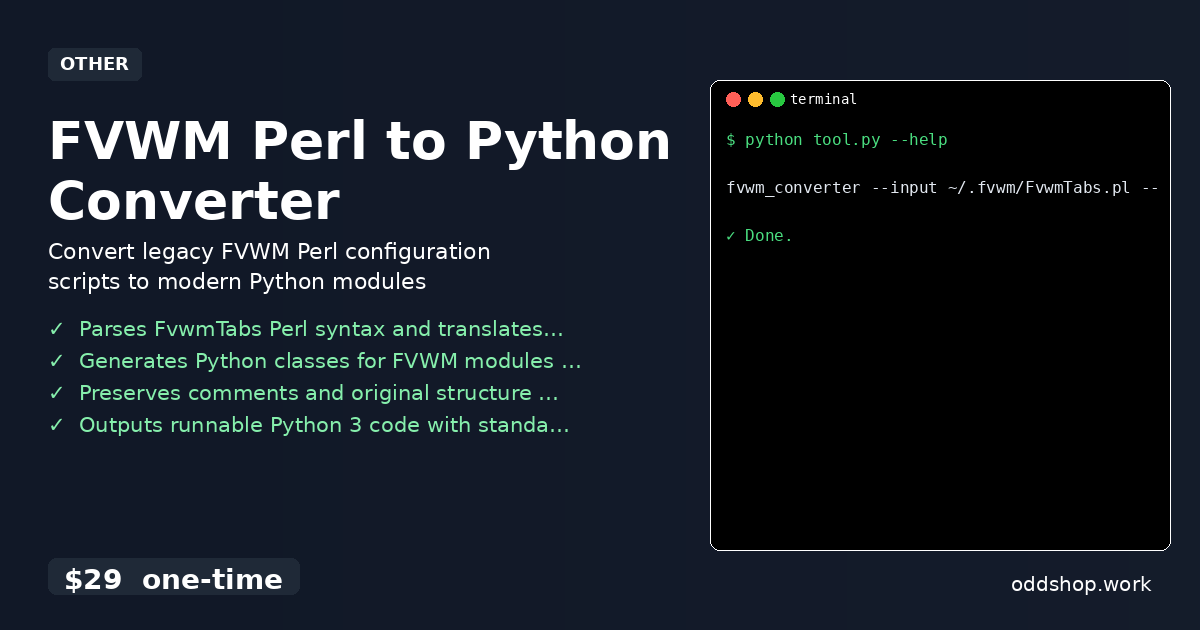
FVWM users who rely on Perl scripts for window manager automation often find themselves stuck in legacy codebases. The FVWM Perl to Python Converter helps bridge that gap, translating existing Perl modules into clean, modern Python code. If you’re managing custom FVWM setups and avoiding Perl dependencies, this tool can save you hours of manual rework.
The Manual Way (And Why It Breaks)
Manually converting Perl scripts to Python for FVWM automation is a tedious and error-prone process. You must read through each line of Perl code, understand its purpose, then rewrite equivalent logic in Python, often dealing with subtle differences in syntax and library usage. This process becomes especially difficult when handling complex FVWM scripting tasks such as menu generation or module behavior definitions. Many developers avoid updating their configurations simply because the manual effort required is not worth the payoff. For system admins and desktop customization enthusiasts, the lack of a proper FVWM Perl to Python converter often leads to outdated setups. The lack of automation here means that even small updates can require hours of rework.
The Python Approach
If you’re working with FVWM scripting and want to modernize your codebase, a Python translation can streamline your automation efforts. Here’s a small snippet that mimics some of the logic an FVWM Perl to Python Converter might generate:
import os
import sys
from pathlib import Path

# Define FVWM module paths
fvwm_module_path = Path("~/.fvwm/modules").expanduser()
fvwm_menu_path = Path("~/.fvwm/menus").expanduser()

# Check if FVWM configuration directory exists
if not fvwm_module_path.exists():
    print("FVWM module directory not found.")
    sys.exit(1)

# Function to load and process each Perl script
def process_fvwm_script(script_path):
    with open(script_path, "r") as file:
        content = file.read()

    # Extract menu definitions and generate Python class
    menu_lines = [line for line in content.splitlines() if "Menu" in line]
    print(f"Found {len(menu_lines)} menu entries in {script_path}")

# Scan and process all Perl scripts in module directory
for script in fvwm_module_path.glob("*.pl"):
    process_fvwm_script(script)
This code reads Perl script files, extracts menu definitions, and outputs how many menu entries it found. It handles basic FVWM module loading and parsing, though it lacks full support for Perl-specific syntax. You’d still need to manually translate complex conditional logic, function calls, and FVWM-specific modules.
What the Full Tool Handles
The full FVWM Perl to Python Converter automates most of that manual effort:
- Parses FvwmTabs Perl syntax and translates core functions
- Generates Python classes for FVWM modules and menu definitions
- Preserves comments and original structure where possible
- Outputs runnable Python 3 code with standard library imports
- Includes a validation mode to check translation accuracy
- Works with standard FVWM scripting constructs and window manager automation patterns
As part of the broader FVWM automation toolset, this tool makes it easier to move away from Perl dependencies without losing functionality.
Running It
The tool is simple to run from the command line:
fvwm_converter --input ~/.fvwm/FvwmTabs.pl --output ~/.fvwm/fvwmtabs.py
The --input flag specifies the source Perl file, while --output defines the generated Python file. You can also add --validate to test if the translation matches the original behavior.
Get the Script
If you’re tired of rebuilding FVWM configurations manually, skip the build and get the full solution now. The FVWM Perl to Python Converter brings modern Python support to your desktop automation without the hassle.
Download FVWM Perl to Python Converter →
$29 one-time. No subscription. Works on Windows, Mac, and Linux.
Built by OddShop — Python automation tools for developers and businesses.