Converting academic papers from Word to publishable formats requires hours of manual work that breaks consistency and introduces errors. A proper journal article converter eliminates these bottlenecks by automating the entire workflow from document processing to format compliance.
The Manual Way (And Why It Breaks)
Processing academic articles manually means opening each Word document, copying content to different systems, manually converting equations to proper formats, and rebuilding citation structures for each output target. You spend hours fixing font embedding issues for PDFs, ensuring mathematical expressions render correctly in HTML, and creating JATS XML that meets Open Journal Systems requirements. Each manual step introduces potential formatting inconsistencies, citation mismatches, and structural errors that require additional review cycles. Academic publishing workflows become particularly fragile when handling batch operations across multiple articles simultaneously.
The Python Approach
This basic snippet handles the core file reading and path management needed for document conversion:
from pathlib import Path
import docx
from docxtpl import DocxTemplate

def process_article_batch(input_path, output_path):
    input_dir = Path(input_path)
    output_dir = Path(output_path)
    output_dir.mkdir(exist_ok=True)

    # Process each Word document
    for doc_file in input_dir.glob("*.docx"):
        doc = docx.Document(doc_file)

        # Extract metadata and content
        metadata = extract_doc_metadata(doc)
        content = extract_formatted_content(doc)

        # Generate output paths
        base_name = doc_file.stem
        pdf_path = output_dir / f"{base_name}.pdf"
        html_path = output_dir / f"{base_name}.html"

        # Convert content to different formats
        convert_to_pdf(content, pdf_path)
        convert_to_html(content, html_path)
This handles basic document reading and path management, but lacks the sophisticated formatting preservation, equation handling, and JATS XML generation needed for production workflows. Real academic publishing requires deeper integration with citation processors and format-specific validation.
What the Full Tool Handles
• Converts .docx files to PDF with embedded fonts and proper formatting
• Generates HTML output with semantic markup for web publication
• Creates JATS XML files compliant with NLM standards for OJS import
• Preserves mathematical equations, citations, and bibliographic references
• Batch processes multiple articles with single command execution
The journal article converter handles the complex mapping between Word’s internal structure and scholarly publishing standards automatically.
Running It
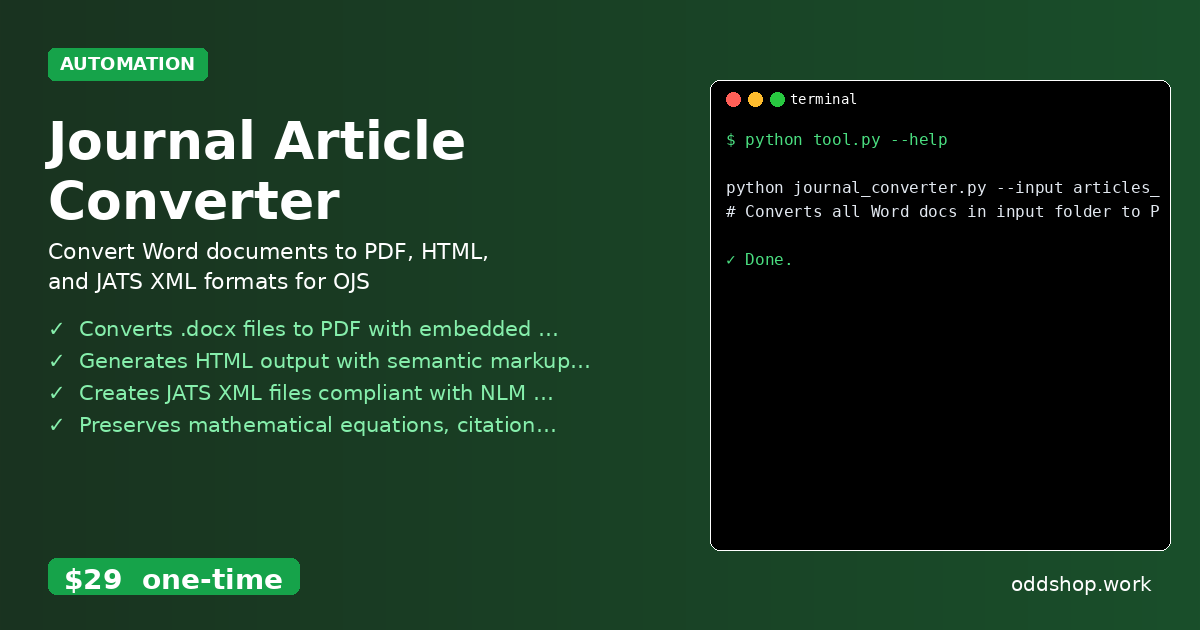
python journal_converter.py --input articles_folder/ --output converted_articles/
# Converts all Word docs in input folder to PDF, HTML, and JATS XML
The --input flag specifies your source directory containing Word documents, while --output defines where converted files will be saved. Each input document generates three output formats in the destination folder.
Get the Script
Skip the build phase and get production-ready functionality immediately.
Download Journal Article Converter →
$29 one-time. No subscription. Works on Windows, Mac, and Linux.
Built by OddShop — Python automation tools for developers and businesses.