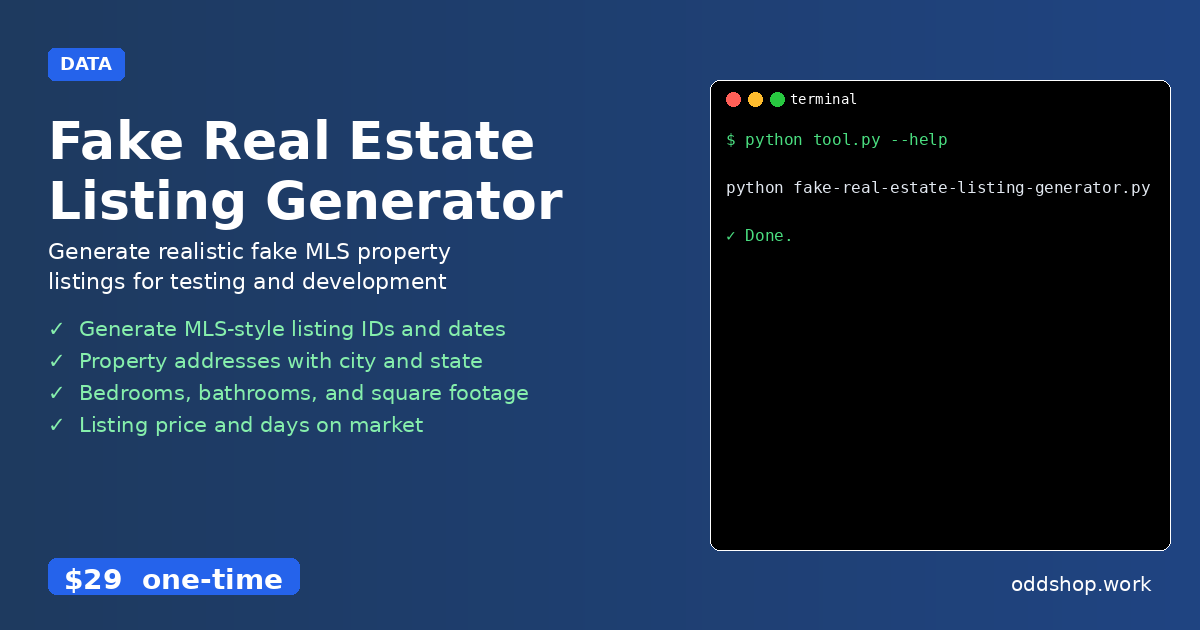
MLS property listings are often scattered across multiple sources, and manually compiling them into a usable dataset can be tedious and error-prone. If you’re working on real estate data projects, you’ve probably encountered the time-consuming task of gathering and structuring property information from various public or private feeds. That’s where automation tools like the 500 Synthetic MLS Property Listings come in.
The Manual Way (And Why It Breaks)
Manually collecting MLS property listings involves a lot of clicking, copying, and pasting. You might start by visiting a few real estate websites, then download spreadsheets or manually extract data point by point. The process is slow and repetitive, especially when you need consistent field formats across dozens of entries. Real estate scraping efforts often fall short when dealing with inconsistent structures or missing fields in raw data. You end up spending hours on data cleaning rather than analysis. For developers, this kind of manual effort is a blocker that reduces productivity and increases the chance of errors.
The Python Approach
Using Python to automate real estate data collection makes sense when you need large, consistent datasets. Here’s a script that generates synthetic MLS property listings by reading from a sample CSV file and applying realistic variations to each field. It’s not a full-blown scraper but a helpful starting point for building property database tools.
import pandas as pd
import random
from pathlib import Path

# Load a base CSV with template data
base_df = pd.read_csv("property_template.csv")

# Define ranges and lists for synthetic variation
bedrooms = [1, 2, 3, 4, 5]
bathrooms = [1, 1.5, 2, 2.5, 3, 3.5, 4]
price_range = (100000, 1000000)
size_range = (800, 5000)

# Create a new DataFrame for synthetic listings
synthetic_listings = []

# Generate 500 synthetic entries
for _ in range(500):
    row = base_df.sample(n=1).iloc[0].to_dict()
    row['beds'] = random.choice(bedrooms)
    row['baths'] = random.choice(bathrooms)
    row['price'] = random.randint(*price_range)
    row['sqft'] = random.randint(*size_range)
    row['year_built'] = random.randint(1950, 2023)
    row['property_type'] = random.choice(['Single Family', 'Townhouse', 'Condo', 'Duplex'])
    synthetic_listings.append(row)

# Save to new CSV file
output_df = pd.DataFrame(synthetic_listings)
output_df.to_csv("synthetic_mls_listings.csv", index=False)
This snippet creates a set of synthetic MLS property listings by sampling from a base dataset and assigning random but realistic values to key fields. It doesn’t connect to live sources but is excellent for testing applications, training models, or simulating real estate data scenarios. The main limitation is that it doesn’t pull from actual feeds, so it’s best for development or prototyping rather than production use.
What the Full Tool Handles
- Generates 500 realistic entries with consistent fields like beds, baths, price, and property type.
- Includes fields typical in MLS property listings such as year built, square footage, and listing dates.
- Produces clean, ready-to-use CSV output that works with most data tools and dashboards.
- Mimics real-world data structures for integration into property database systems.
- Offers synthetic data generation that avoids legal or privacy concerns of real scraping.
- Ensures uniform formatting and no missing fields, even with large batches.
Running It
To get started, download the synthetic CSV dataset:
Download CSV: oddshop.work/downloads/synthetic-mls-listings-500.zip
The file contains 500 rows of property data with standard fields. You can pass flags to modify the output if needed, such as changing the number of entries or filtering by property type. The script is designed to work across platforms and can be run with Python 3.8 or higher.
Get the Script
Skip the build and get a ready-to-use tool instead.
Download 500 Synthetic MLS Property Listings →
$29 one-time. No subscription. Works on Windows, Mac, and Linux.
Built by OddShop — Python automation tools for developers and businesses.