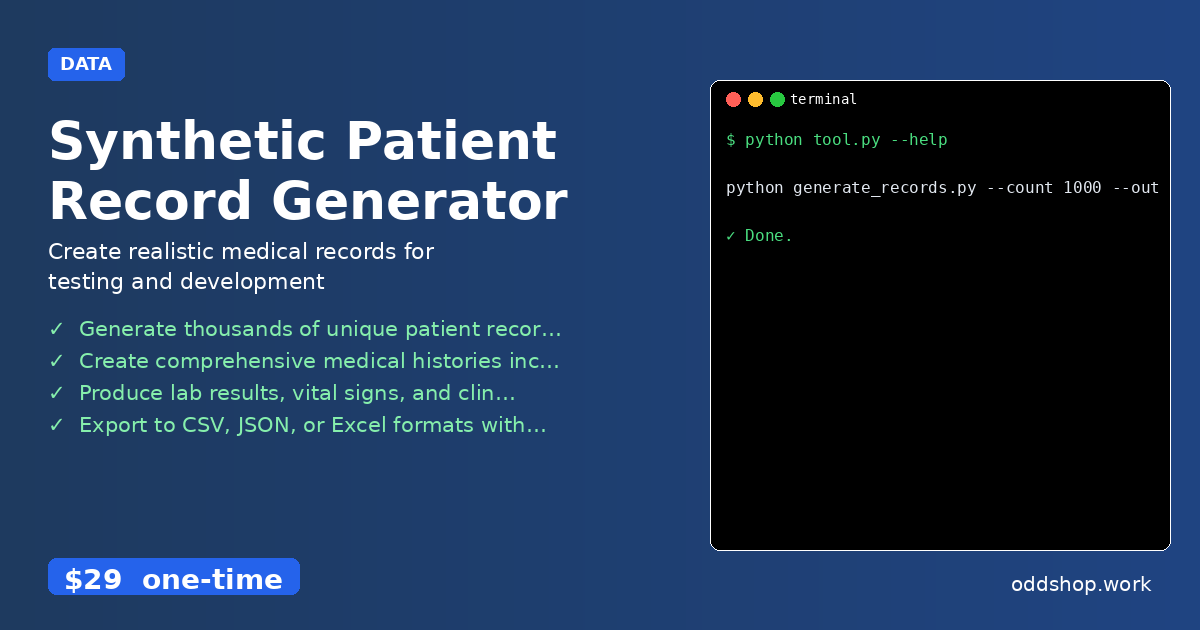
synthetic patient records are essential for testing healthcare applications, but manually creating them is a tedious task. You end up copying data, fudging dates, or using outdated tools that don’t meet industry standards. The process is slow, error-prone, and often fails to maintain privacy compliance, especially when working with HIPAA-safe datasets.
The Manual Way (And Why It Breaks)
Creating synthetic patient records manually means copying and pasting from templates or writing out data by hand. You might be using Excel spreadsheets with static names, fake addresses, and random dates, but this approach quickly becomes unwieldy. It’s especially problematic when you need to generate thousands of test entries or ensure that your datasets are HIPAA compliant. The process is time-consuming and often leads to inconsistencies. Healthcare data generation using these methods often falls short of what developers need for real-world simulation.
The Python Approach
This snippet automates healthcare data generation by generating realistic, randomized patient data. It uses Python libraries to simulate medical records including names, dates of birth, and diagnosis codes. This approach allows for a large volume of patient data in seconds, making it ideal for healthcare automation scripts. It’s not a full replacement for real datasets but provides a practical solution for testing and development work.
import pandas as pd
import numpy as np
from datetime import datetime, timedelta
import random

# Load a list of common surnames and first names
surnames = ['Smith', 'Johnson', 'Williams', 'Brown', 'Jones']
first_names = ['James', 'Mary', 'John', 'Patricia', 'Robert']

# Generate synthetic patient data
def generate_patient_records(n=10000):
    records = []
    for i in range(n):
        # Randomly assign name
        first = random.choice(first_names)
        last = random.choice(surnames)

        # Random DOB between 1950 and 2005
        dob = datetime(1950, 1, 1) + timedelta(days=random.randint(0, (2005 - 1950) * 365))

        # Random diagnosis code (simulated)
        diagnosis = 'A00' if random.random() < 0.3 else 'B00' if random.random() < 0.6 else 'C00'

        # Random gender
        gender = random.choice(['M', 'F'])

        # Random zip code
        zip_code = f"{random.randint(10000, 99999)}"

        records.append({
            'first_name': first,
            'last_name': last,
            'date_of_birth': dob.strftime('%Y-%m-%d'),
            'gender': gender,
            'diagnosis_code': diagnosis,
            'zip_code': zip_code
        })
    return pd.DataFrame(records)

# Generate and save the dataset
df = generate_patient_records(10000)
df.to_csv('synthetic_patient_data.csv', index=False)
This script produces a structured patient dataset that mimics real-world healthcare data. It’s efficient for developers who need to simulate medical records in a controlled environment. However, it’s limited in its realism compared to full synthetic patient records that include more complex demographics and clinical details.
What the Full Tool Handles
- Realistic patient demographics such as names, dates of birth, and zip codes
- HIPAA compliant datasets to ensure privacy in development and testing
- Medical record automation features for generating diagnosis codes and patient history
- Customizable outputs for different use cases, including CSV and JSON formats
- Patient data simulation with realistic variability in age, conditions, and gender
- Python healthcare scripting support for integration into larger testing frameworks
Running It
To get started, download the dataset using the link below:
Download CSV: oddshop.work/downloads/synthetic-patient-records-10k.zip
Once you’ve downloaded the file, you can pass flags to specify output directories or data formats. The tool is designed to be run from the command line or integrated into your Python scripts for automation. The output includes a clean CSV with 10,000 synthetic patient records, ready for use in your applications.
Get the Script
Skip the build and jump straight to the solution. We’ve already done the work for you.
Download 10,000 Synthetic Patient Records (HIPAA-safe) →
$29 one-time. No subscription. Works on Windows, Mac, and Linux.
Built by OddShop — Python automation tools for developers and businesses.