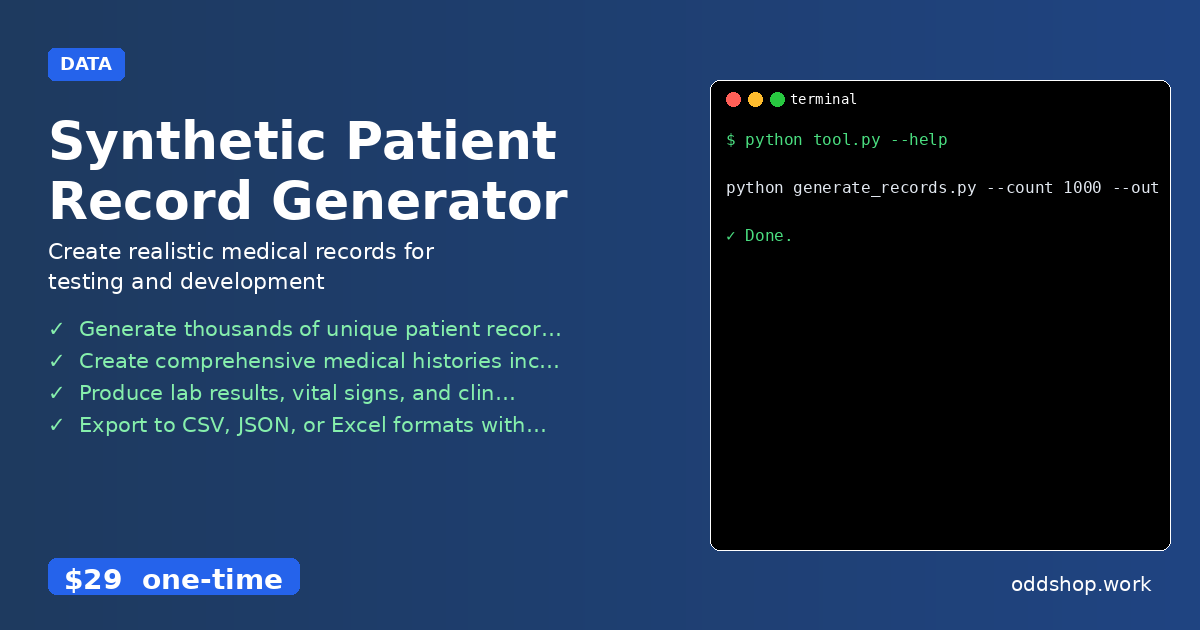
Synthetic patient data is essential for healthcare software testing, but manually crafting it is tedious and error-prone. Without proper tools, developers often fall back to copying real records or creating fake data by hand — both of which risk privacy violations and inaccurate simulations. The result? Flawed applications that fail in real-world use.
The Manual Way (And Why It Breaks)
Creating healthcare datasets by hand is a painstaking process. You start with basic demographics like names, dates of birth, and addresses — but then you need to build realistic medical histories. Someone might manually list out a patient’s allergies, medications, and lab results, all while ensuring that the data fits HIPAA guidelines. It’s time-consuming, and it’s easy to miss edge cases or introduce inconsistencies. This process also doesn’t scale; generating thousands of test records becomes impractical. The lack of structure often leads to poor healthcare data automation, especially when you’re trying to simulate clinical workflows.
The Python Approach
If you need to simulate patient data quickly, a Python script can automate the generation of synthetic patient data with realistic attributes. Here’s an example that shows how to build a minimal yet functional version of such a tool using Python libraries. This snippet generates basic patient records, including names, dates of birth, and a simple medical condition. While not comprehensive, it shows how easy it can be to get started with synthetic patient data generation.
import csv
import random
from datetime import datetime, timedelta

# List of fake names to use
names = ["John Smith", "Jane Doe", "Michael Brown", "Sarah Johnson", "David Wilson"]
# Predefined conditions
conditions = ["Diabetes", "Hypertension", "Asthma", "Arthritis", "Migraine"]
# Output file
output_file = "patients.csv"

# Generate 100 records
records = []
for i in range(100):
    name = random.choice(names)
    dob = datetime.now() - timedelta(days=random.randint(20*365, 80*365))  # Random age between 20 and 80
    condition = random.choice(conditions)
    records.append({
        "name": name,
        "date_of_birth": dob.strftime("%Y-%m-%d"),
        "condition": condition
    })

# Write to CSV
with open(output_file, "w", newline="") as f:
    writer = csv.DictWriter(f, fieldnames=["name", "date_of_birth", "condition"])
    writer.writeheader()
    writer.writerows(records)

print(f"Generated {len(records)} patient records in {output_file}")
This script creates a basic CSV file with patient data using Python’s built-in libraries. It has limitations — no SSN validation, no lab results, and no real clinical terminology. But it gets you started on a path toward generating synthetic patient data programmatically.
What the Full Tool Handles
The Synthetic Patient Record Generator tackles more complex aspects of healthcare data automation:
- Generates thousands of unique patient records with realistic names, DOB, SSN, and addresses.
- Creates comprehensive medical histories including conditions, medications, allergies, and procedures.
- Produces lab results, vital signs, and clinical notes with proper medical terminology.
- Exports data in CSV, JSON, or Excel formats with configurable field mappings.
- Allows customization of demographic distributions and medical condition prevalence by age/gender.
- Ensures all output is HIPAA compliant, making it safe for development and testing.
With these features, the tool helps developers simulate real-world patient scenarios, test database systems, and validate EHR workflows without ever touching actual patient records.
Running It
To generate synthetic patient data with the full tool, run this command:
python generate_records.py --count 1000 --output patients.csv --conditions diabetes,hypertension
This command creates 1000 records, writes them to patients.csv, and includes diabetes and hypertension as common conditions. You can add more flags to customize demographics or export formats. The tool supports flexible configurations, making it easy to tailor synthetic patient data to your specific testing needs.
Get the Script
If you’re ready to skip the build and get a full-featured solution, the Synthetic Patient Record Generator is ready for you.
Download Synthetic Patient Record Generator →
$29 one-time. No subscription. Works on Windows, Mac, and Linux.
Built by OddShop — Python automation tools for developers and businesses.